Saturday, January 29, 2011

Give your mind a break

About one in ten Americans practice meditation, and the number seems to be growing. The practice has been around since antiquity, and today the term means different things to different people. It's become an avenue of research looking into its health benefits. According to Wikipedia:
Since the 1960s, meditation has been the focus of increasing scientific research of uneven rigor and quality. In over 1,000 published research studies, various methods of meditation have been linked to changes in metabolism, blood pressure, brain activation, and other bodily processes. Meditation has been used in clinical settings as a method of stress and pain reduction.
A new research report finds that those who meditated for about 30 minutes a day for eight weeks had measurable changes in gray-matter density in parts of the brain associated with memory, sense of self, empathy and stress.
M.R.I. brain scans taken before and after the participants’ meditation regimen found increased gray matter in the hippocampus, an area important for learning and memory. The images also showed a reduction of gray matter in the amygdala, a region connected to anxiety and stress. A control group that did not practice meditation showed no such changes.
Britta Hölzel, a psychologist at Massachusetts General Hospital and Harvard Medical School and the study’s lead author, said the participants practiced mindfulness meditation, a form of meditation that was introduced in the United States in the late 1970s. It traces its roots to ancient Buddhist techniques.
“The main idea is to use different objects to focus one’s attention, and it could be a focus on sensations of breathing, or emotions or thoughts, or observing any type of body sensations,” she said. “But it’s about bringing the mind back to the here and now, as opposed to letting the mind drift.”
Other research: a 2009 study suggests that meditation may reduce blood pressure in patients with coronary heart disease. And a 2007 study found that meditators have longer attention spans.

It makes sense when you consider that from waking to sleeping we are bombarded with artificial sensations and distractions created by other human beings. Which is why simply walking in unstructured nature also contributes to our well-being.

Thursday, January 27, 2011

Stand up, live forever

You're reading this sitting down, aren't you? Hope you live long enough to make it to the end. Sitting is one of the worst things we can do for our health. I've written about this before, but here's more:
A new study has found that it is not just the length of time people spend sitting down that can make a difference, but also the number of breaks that they take while sitting at their desk or on their sofa. Plenty of breaks, even if they are as little as one minute, seem to be good for people’s hearts and their waistlines.
The study found that prolonged periods of sedentary time, even in people who also spent some time in moderate-to-vigorous exercise, were associated with worse indicators of cardio-metabolic function and inflammation, such as larger waist circumferences, lower levels of HDL (“good”) cholesterol, higher levels of C-reactive protein (an important marker of inflammation) and triglycerides (blood fats). 
Oh man, that's bad.
However, the study also found that, even in people who spent a long time sitting down, the more breaks they took during this time, the smaller their waists and the lower the levels of C-reactive protein.
Whew! That's good.
“Our research showed that even small changes, which could be as little as standing up for one minute, might help to lower this health risk," says Dr. Genevieve Healy, a research fellow at the School of Population Health, The University of Queensland, Australia.
She should know. Those Aussies are always jumping up to chase a kangaroo.


Here are some of her suggestions:
  • Standing up to take phone calls
  • Walking to see a colleague rather than phoning or emailing
  • Having standing meetings or encouraging regular breaks during meetings for people to stand up
  • Centralising things such as rubbish bins and printers so that you need to walk to them
  • Taking the stairs instead of the lift where possible. 
  • Going to a bathroom on a different level 
By "different level," does she mean metaphysically?

Tuesday, January 25, 2011

If you have to go to the emergency room

You should know that patience will get you nowhere. Smart Money reports:
As nurses and doctors struggle to look after everyone, sometimes "somebody who doesn't know they're having a heart attack, who thinks they're just having shoulder pain, might not get noticed," says Dr. William Mileski, director of the emergency department at the University of Texas Medical Branch in Galveston.

In fact, sitting quietly and respectfully could kill you, doctors say. In 2007, 200 emergency physicians nationwide said they knew of patients who died while waiting in the ER for hospital beds, according to the latest figures from the American College of Emergency Physicians. The moral: Speak up if you think the nurse or doctor has misunderstood your symptoms and don't be afraid to ask them to repeat what you said back to you to make sure your message is clear, says Dr. Mileski.

Giving your doctor a heads up before you get to the ER, especially if he or she has privileges at the hospital, might get you through the door quicker. Your doctor might also suggest another hospital that is better equipped to treat you, says May. Or he may make an exception to see you after hours.
Speak up! More advice in the article, and more here.

Monday, January 24, 2011

Eat your berries, dude

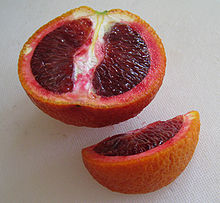
Anthocyanins contribute pigmentation to blood oranges.
One in three Americans is said to have high blood pressure, or hypertension. A new study by British and Harvard scientists has found that bioactive compounds in blueberries called anthocyanins offer protection against hypertension. 

Compared with those who do not eat blueberries, those eating at least one serving a week reduce their risk of developing the condition by 10 per cent.

The researchers looked at the diets of 150,000 people.
Dietary information identified tea as the main contributor of flavonoids, with apples, orange juice, blueberries, red wine, and strawberries also providing important amounts. When the researchers looked at the relation between individual subclasses of flavonoids and hypertension, they found that participants consuming the highest amounts of anthocyanins (found mainly in blueberries and strawberries in this US-based population) were eight per cent less likely to be diagnosed with hypertension than those consuming the lowest amounts. The effect was even stronger in participants under 60.
The effect was strongest for blueberry rather than strawberry consumption. I guess the strawberry lobby will be up in arms over this.

More at Wikipedia on the health properties of blueberries and anthocyanins.

Wednesday, January 19, 2011

Getting enough B12?

It's not a good idea to fixate on one vitamin or supplement, because these things interact with each other. But an article about Vitamin B12 caught my eye.

Apparently a deficiency is rare: about 1 in 1,000 Americans. For the elderly it goes up, however: about 15% of elderly people.

"B12 deficiency is much more common than the textbooks and journal articles say it is," says Alan Pocinki, an internist in Washington D.C.

Here are some things to consider.
Symptoms of low B12 include anemia, depression, dementia, confusion, loss of appetite and balance problems. Long-term deficiency can bring severe anemia, nerve damage and neurological changes that may be irreversible.

The deficiency rate is much higher among people who don't eat meat or dairy products, people with absorption problems, people taking acid-blocking medications and those with Type 2 diabetes who take the drug Metformin.

Several studies have shown that some symptoms of B12 deficiency, particularly early problems with cognitive function, can be apparent even when patients' blood levels are still in the normal range.

A high level of folic acid can mask symptoms of B12 deficiency, and many people are getting more folic acid than they realize. Since 1996, all enriched flour must contain folic acid to reduce the risk of neural-tube defects.
A good thing to discuss with your doctor. More on B12 at Wikipedia, including a list of sources in food. The top five are:

Panfried beef liver
Simmered turkey giblets
Braunschweiger pork liver sausage
Raw pacific oysters
Cooked Alaska king crab
Raw clams

How much of these do you eat?

Tuesday, January 18, 2011

Come out of your shell, live forever

Researchers are discovering the health value of social relationships, not just feel good value but real physical value.

Social connections influence our long-term health in ways every bit as powerful as adequate sleep, a good diet, and not smoking, doctors at the Harvard Medical School say. 
Conversely, a relative lack of social ties is associated with depression and later-life cognitive decline, as well as with increased mortality. One study, which examined data from more than 309,000 people, found that lack of strong relationships increased the risk of premature death from all causes by 50% — an effect on mortality risk roughly comparable to smoking up to 15 cigarettes a day, and greater than obesity and physical inactivity.


Connecting with others helps relieve harmful levels of stress, which can adversely affect coronary arteries, gut function, insulin regulation, and the immune system. Caring behaviors trigger the release of stress-reducing hormones.
So get out on those ice-covered roads and go see someone!

Monday, January 17, 2011

New gadgets to monitor your aging parents

Here are two of the new devices you can use to remotely watch over a loved one.

Sonamba
For about $200 (plus monitoring fees of about $100 per month), you can buy any number of home monitoring devices that use sensors to alert caregivers if their charge has fallen or might need medical attention, according to Caring.com . But for an additional $349.99, you can upgrade to the Sonamba , which uses sound and motion sensors to monitor all movements, alerting caregivers with periodic text messages like "all is well," or "attention needed."

The Sonamba, which looks like a digital picture frame, is placed somewhere in the house; smaller sensors are placed in other rooms so that the device can theoretically monitor most of a home. Something else experts like: It doesn't require technical expertise on the part of the patient. Although the $549.99 price and the $39 monthly fee are higher than those of many other devices on the market, the Sonamba does have additional bells and whistles — like reminder messages about doctors' appointments and medication routines.

Lifecomm mPERS 
Lifecomm's new mobile personal emergency response system (mPERS) uses cellular network signals to transmit messages to a caregiver in the event of a fall. Just slightly bigger than an iPod Nano, the wearable battery-powered belt clip, watch or necklace has as an embedded GPS (in case help is needed away from home) and a sensor that tracks the number of steps a person takes, along with their activity level. Veer from the norm and the device sends a caregiver alert. It also comes with online support tools where caregivers can sign up for things like low-battery alerts.

The system works well as long as it's in range of a strong cell signal — and there's still no getting around the fact that its owner must remember to wear it to get the high-tech benefits. The company says the device will be "comparable" in price to other systems (Wellcore offers a similar product for $199 with a $49.99 monthly fee).