Showing posts with label technology. Show all posts

Wednesday, August 22, 2012

Miracles and wonders: lab in a shoebox


Checking to see if she has a brain.
A scientific instrument featured on CSI and CSI: Miami for instant fingerprint analysis is forging another life in real-world medicine, helping during brain surgery and ensuring that cancer patients get effective doses of chemotherapy.
The instrument, called a "desorption electrospray ionization" mass spectrometer, or DESI, is about the size of a shoebox. Students have  carried it into a grocery store and held it close to fruits and vegetables to detect pesticides and microorganisms. 
It has also been used to identify biomarkers for prostate cancer and to detect melamine, a potentially toxic substance that showed up in infant formulas in China in 2008. In addition, DESI can detect explosives on luggage.
Now scientists want to  test the instrument in the operating room during brain cancer surgery, comparing it with traditional analysis of tissue samples by pathologists.
DESI can analyze tissue samples and help determine the type of brain cancer, the stage and the concentration of tumor cells. It also can help surgeons identify the margins of the tumor to assure that they remove as much of the tumor as possible.
 Innovations in medicine like this are happening all the time, and we are hardly aware of them.

Tuesday, August 7, 2012

The story of your health in a black box


Yikes! That hurts!
For years I thought that one answer to our broken healthcare system was electronic health records. I still think so, but with a lot of caveats.

The federal government is pushing hard for their adoption. Physicians, driven by the promise of better care, cost savings and nearly $23 billion in new federal incentive payments, are racing to turn their scribbled medical records into digital files, Smart Money reports.
Thirty-five percent of hospitals now use such systems, more than double the share two years ago, according to U.S. government figures. But for all the hype about electronic records, little attention has been paid to what some say is a serious weak spot: When those sensitive bits and bytes fall into the wrong hands, it's often patients who feel the pain.
Here's the trouble.
Since 2009, there have been more than 420 security breaches involving the records of some 19 million patients, according to the U.S. Department of Health and Human Services' Office for Civil Rights. And such breaches are on the rise. A December 2011 report by the Ponemon Institute, a security-research firm, found that the frequency of data losses and thefts among health care organizations increased 32 percent over the previous year.
This is one reason I'm a skeptic about a national healthcare system. Already too many computer systems are familiar with my body.

Monday, August 6, 2012

A doctor in your hand

Is there a doctor in the House?

Health-related apps for smart phones are coming of age. Here are some of the latest.
  • One of the latest device-and-app creations to pass muster with the federal Food and Drug Administration is iBGStar, a blood glucose meter that attaches to iPhones or iPads for diabetes monitoring. It's a product of Bridgewater, N.J.-based Sanofi, and sells at Apple retail stores and Walgreens drugstores for about $100 and $75, respectively.
  • Heart-EKG uses the iPhone's microphone or camera flash to calculate users' average number of heartbeats per minute or to take their pulse, after placing the phone over an artery, and activating the app. Dallas-based Surich Technologies says the app is handy for aerobic workouts, but isn't intended as a lifesaving monitoring device. It's downloadable from iTunes, for $2.99.
  • The iHealth Wireless Blood Pressure Wrist Monitor, expected on the market in September, measures users' blood pressure directly from their iPhone, iPad or iPod Touch. Its app records systolic/diastolic numbers, heart rate and pulse wave, and can chart blood pressure readings, says Karyn Anderson, spokeswoman for Mountain View, Calif.-based iHealth Lab.
  • AliveCor Heart Monitor has developed an electrode-studded cellphone case that turns the iPhone 4 into an electrocardiogram device that users hold in their hands or place on their chests to detect irregular heart rhythms. Combined with the app, the monitor can analyze, transmit and store an ECG reading for diagnosis. The heart monitor has been through several clinical trials, said physician David Albert, the device's inventor and co-founder of San Francisco-based AliveCor. He hopes to introduce it for veterinarians' use for dogs, cats and horses later this summer. The device doesn't yet have FDA approval.
  • A cellphone-based E. coli sensor for water and other fluids is under development by a University of California-Los Angeles research team. Commercial manufacture of the system, which uses a lightweight attachment to the phone's camera, could be only two years away, said team leader Aydogan Ozcan, a UCLA associate professor for electrical engineering.
  • San Francisco-based CellScope's otoscope attaches to the phone's camera lens and will enable parents to photograph their child's eardrum, and e-mail the images to medical professionals checking for an ear infection. CEO Erik Douglas says he hopes to get this to market in about a year.

Wednesday, February 1, 2012

You won't have to get sick


Dr. David Agus is a professor of medicine and engineering at the University of Southern California and co-founder of two personalized medicine companies. Here's what he sees in the near future.
The end of illness is near. 
Today, we mostly wait for the body to break before we treat it. When I picture what it will be like for my two children to stay in good health as independent adults in 10 or 20 years, I see a big shift from our current model. 
I see them being able to monitor and adjust their health in real time with the help of smartphones, wearable gadgets—perhaps like small, invisible stickers—to track the inner workings of their cells, and virtual replicas of their bodies that they will play much like videogames, allowing them to know exactly what they can do to optimize every aspect of their health.What happens when I take drug x at dosage y? How can I change the expression of my genes to stop cancer? Would eating more salmon and dark chocolate boost my metabolism and burn fat? Can red wine really lower my risk of heart attack?
From a drop of their blood, they will be able to upload information onto a personal biochip that can help to create an individualized plan of action, including both preventive measures and therapies for identified ailments or signs of "unhealthiness." (Other body fluids—like tears and saliva—might be routinely tested, too.) They would be on the lookout for problems like imbalances in blood-sugar control, a risk factor for diabetes, and uncontrolled cell growth, which could signal cancer. Their doctors won't just examine them once a year; they will continually monitor the next generation of patients, offering advice along the way.
And there's more. 
What is equally exciting is that this patient data will be added to a universal database that can be aggregated by powerful search engines like Google and constantly fed into new trials and experiments—speeding up our understanding of which drugs work best for which people. The database might show, for example, that people with a particular genetic profile respond to one type of cancer treatment but not another. As more people anonymously add their health data, this database would become more and more effective as a tool for preventive medicine.
Our health care "system" -- which wasn't designed as a system and doesn't operate as one -- is on its last legs.
Today, most people who are concerned about their health follow sweeping, general guidelines. If you want to lose weight, you are likely to pick a diet that advises eating more fibrous vegetables and cutting back on processed sugar. If you want to reduce your risk for cancer, you avoid tobacco smoke, exercise regularly and take early detection seriously.
The problem with health care today is that we don't know enough about the body to practice preventive medicine actively. With limited knowledge, diagnostic medicine makes sense. If we don't know what we're trying to prevent or how best to do it, we have to wait for an obvious symptom to emerge in order to take action. At that point, we're usually treating a disease that has had ample opportunity to progress.
Read this twice and call me in the morning.

Tuesday, September 20, 2011

Let the games begin

Online gamers have deciphered the structure of an enzyme of an AIDS-like virus that had thwarted scientists for a decade.
Their target was a monomeric protease enzyme, a cutting agent in the complex molecular tailoring of retroviruses, a family that includes HIV. Figuring out the structure of proteins is vital for understanding the causes of many diseases and developing drugs to block them.
Foldit, developed in 2008 by the University of Washington, is a video game in which gamers, divided into competing groups, compete to unfold chains of amino acids -- the building blocks of proteins -- using a set of online tools.
To the astonishment of the scientists, the gamers produced an accurate model of the enzyme in just three weeks. Cracking the enzyme "provides new insights for the design of antiretroviral drugs," says the study, referring to the lifeline medication against the human immunodeficiency virus (HIV). 
"We wanted to see if human intuition could succeed where automated methods had failed," Firas Khatib of the university's biochemistry lab said in a press release. "The ingenuity of game players is a formidable force that, if properly directed, can be used to solve a wide range of scientific problems."
Hey kids, next time your parents get crazy about you playing video games ...

Sunday, February 27, 2011

Your health in digits

This could be you!
I've long believed that one answer to our healthcare mess is digital health records. I look at my family doctor's office, and I see mounds of paper, a half dozen clerks frantically shuffling them, and a wall of manilla folders holding the health histories of hundreds of people.

Above all this is a fire sprinkler. Not at all reassuring.

Last year I went to an eye surgeon who was introducing digital records to his practice. As I watched from the chair, he and his assistant labored at a laptop to enter my data into the many fields of my record.

Right there we see the problems. There's not a lot of money lying around in family practices. Given the absence of standards, why should my doctor invest in something that may be outdated next year? And given all the upcoming changes in the government's role, how could anyone make a rational decision? And as my eye surgeon demonstrated, it's not as simple as it seems.

Digitalization makes a lot of sense. Each year there are tens of thousands of phone calls from pharmacists to physicians to clarify prescriptions. I've experience this. Throw out the little paper pads, type it into a gizmo hanging on your belt and off it goes to the pharmacy. Plus, the gizmo could warn both about drug interactions and the like.

The government has got it in its head (oxymoron alert!) that it's going to push everyone to a digital world.
In the 2009 economic recovery package, the administration and Congress allocated billions — the current estimate is $27 billion — in incentives for doctors and hospitals to adopt electronic records. 
Late last year, the administration, working with health professionals and the technology industry, set out a roadmap for what digital records should include and how they should be used, for doctors to qualify for incentive payments, typically up to $44,000. The program begins this year, and the requirements for using the records to report and share health information increase in stages through 2015. After that, penalty payments from Medicare and Medicaid kick in for doctors who don’t meet the use and reporting rules.
Carrot and stick. We'll see how that works out.

Wednesday, February 23, 2011

This is your brain on electricity

"Yes, Midge, I'm dying."

Whether cell phones hurt our brains -- and I'm not talking about the effects of chatting with your idiotic friends or having your boss find you on Saturday -- has been debated for years. A new study adds to the clamor:
Researchers from the National Institutes of Health have found that less than an hour of cellphone use can speed up brain activity in the area closest to the phone antenna, raising new questions about the health effects of low levels of radiation emitted from cellphones. 
The researchers urged caution in interpreting the findings, because it is not known whether the changes, which were seen in brain scans, have any meaningful effect on a person’s overall health.
As with the health effects of coffee, I urge you to remain calm: pour a cup and call a friend to talk this over.

The leader of the research, Dr. Nora D. Volkow, director of the National Institute on Drug Abuse, said:
“Unfortunately this particular study does not enlighten us in terms of whether this is detrimental or if it could even be beneficial. It just tells us that even though these are weak signals, the human brain is activated by them."
Dr. Volkow said future research may even show that the electromagnetic waves emitted from cellphones could be used to stimulate the brain for therapeutic reasons.
She said the research should not set off alarms about cellphone use because simple precautions like using a headset or earpiece can alleviate any concern. 
“It does not in any way preclude or decrease my cellphone utilization,” she said.
Never trust headlines: you have to read to the end of the New York Times article to get that.

"Hey, I have an idea!"
Meantime, we get this:
New scientific research suggests that by stimulating parts of their brains electrically, people can be induced to think more creatively than they normally do.  
The researchers took 60 normal, healthy, right-handed volunteers and asked them to try to solve a task that required clever insight. All of them were told they'd be receiving some kind of brain stimulation. But just 20% of the control group (who received no stimulation) could solve the task. That's compared with 60% of the volunteers who received electrical jolts to their brain--cathode stimulation of the left ATL (anterior temporal lobe) to suppress activity and anodal stimulation of the right ATL to increase activity.
Shocking.

Monday, January 17, 2011

New gadgets to monitor your aging parents

Here are two of the new devices you can use to remotely watch over a loved one.

Sonamba
For about $200 (plus monitoring fees of about $100 per month), you can buy any number of home monitoring devices that use sensors to alert caregivers if their charge has fallen or might need medical attention, according to Caring.com . But for an additional $349.99, you can upgrade to the Sonamba , which uses sound and motion sensors to monitor all movements, alerting caregivers with periodic text messages like "all is well," or "attention needed."

The Sonamba, which looks like a digital picture frame, is placed somewhere in the house; smaller sensors are placed in other rooms so that the device can theoretically monitor most of a home. Something else experts like: It doesn't require technical expertise on the part of the patient. Although the $549.99 price and the $39 monthly fee are higher than those of many other devices on the market, the Sonamba does have additional bells and whistles — like reminder messages about doctors' appointments and medication routines.

Lifecomm mPERS 
Lifecomm's new mobile personal emergency response system (mPERS) uses cellular network signals to transmit messages to a caregiver in the event of a fall. Just slightly bigger than an iPod Nano, the wearable battery-powered belt clip, watch or necklace has as an embedded GPS (in case help is needed away from home) and a sensor that tracks the number of steps a person takes, along with their activity level. Veer from the norm and the device sends a caregiver alert. It also comes with online support tools where caregivers can sign up for things like low-battery alerts.

The system works well as long as it's in range of a strong cell signal — and there's still no getting around the fact that its owner must remember to wear it to get the high-tech benefits. The company says the device will be "comparable" in price to other systems (Wellcore offers a similar product for $199 with a $49.99 monthly fee).

Monday, November 22, 2010

What the insurance companies are learning about you

Your online trail is being tracked, and now the insurance companies are following you. From The Wall Street Journal:
Data-gathering companies have such extensive files on most U.S. consumers—online shopping details, catalog purchases, magazine subscriptions, leisure activities and information from social-networking sites—that some insurers are exploring whether data can reveal nearly as much about a person as a lab analysis of their bodily fluids. 
In one of the biggest tests, the U.S. arm of British insurer Aviva PLC looked at 60,000 recent insurance applicants. It found that a new, "predictive modeling" system, based partly on consumer-marketing data, was "persuasive" in its ability to mimic traditional techniques. 
This data increasingly is gathered online, often with consumers only vaguely aware that separate bits of information about them are being collected and collated in ways that can be surprisingly revealing.
A key part of the Aviva test, run by Deloitte Consulting LLP, was estimating a person's risk for illnesses such as high blood pressure and depression. Deloitte's models assume that many diseases relate to lifestyle factors such as exercise habits and fast-food diets. 
Other insurers exploring similar technology include American International Group Inc. and Prudential Financial Inc., executives for those firms confirm. Deloitte, a big backer of the concept, has pitched it in recent months to numerous insurers.

Make you nervous? Let the companies know. Here are their contact pages.

Sunday, November 14, 2010

And the blind shall see

Scientists in Germany have developed a retina implant to restore vision to the blind. Blind patients (mostly suffering from retinitis pigmentosa) were able to see light and dark areas and discern basic shapes only a week after their surgeries. One man was even able to see the difference between objects, and read large letters.

Aaron Saenz writes that retinal implants could restore limited visual sensitivity to thousands or millions around the world, helping them maintain the lives they have built up so carefully.

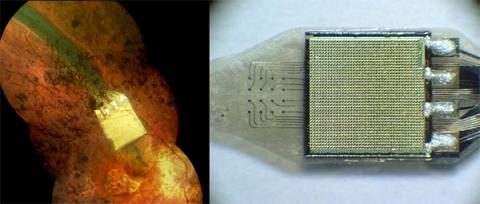
The device is surgically placed under the retina. Light that enters the eye stimulates the photodiodes which send electric currents through the underlying neurons.
An implant in the retina (left) replaces damaged 
retinal light receptors with a photodiode array (right).

Here's the amazing thing.
Implanted patients also reported a sensitivity to infrared light. The retina implant could only provide very basic vision, but it did so in an extended spectrum. Cybernetic implants like these may not only be able to restore sight to the blind, they could let them see things that no normal person has ever seen before with their own eyes.
Infrared imaging is used extensively for military and civilian purposes.
Military applications include target acquisition, surveillance, night vision, homing and tracking. Non-military uses include thermal efficiency analysis, remote temperature sensing, short-ranged wireless communication, spectroscopy, and weather forecasting.
Here's a picture showing how it works. The camera illuminates the scene at infrared wavelengths invisible to the human eye. Despite a dark back-lit scene, active-infrared night vision delivers identifying details, as seen on the display monitor.
Remember those x-ray glasses you wanted so badly when you were a kid?

Monday, October 25, 2010

Should you store your medical record online?

hIt's now possible to store all of you health information online, making it easily accessible anywhere, but only about four percent of people do. Many are afraid of the privacy implications, although these sites use the same technology as banks do to protect your information.

The Wall Street Journal has reviewed three of the most popular sites.
Google Health doesn't have many tools of its own to allow users to evaluate their health. Instead, it focuses on sharing your data with online applications that do such tasks, like the My Diabetes Health Assessment website, which evaluates users' risk of diabetes based on data from their health records.

Microsoft HealthVault, too, has a limited number of self-evaluation tools but connects to a wide variety of helpful services that can extract data from or import data to your profile.

You can accesss WebMD's Health Manager in two main ways: through its public site, WebMD.com, or through the sites of insurance companies and employers that are WebMD customers.
The Journal's assessment:
In the end, we found that each PHR offers a remarkable value for a free application, but none of the three emerged as a clear winner.

Microsoft HealthVault gets high marks for portability, but it has no features for printing. WebMD Health Manager has all of its health evaluation features built in, so you don't have to connect to external applications, but it lacks the ability to export information in some key industry formats. So does Google Health (it says it may add this later), but it does export data to online health applications.

One way to choose among the PHRs is by the applications that link to them. If you want to import data from LifeScan Inc.'s OneTouch glucose monitor into your PHR, for example, currently only HealthVault does that (Google may add this).

On the other hand, if your insurance company (yours or your employer's) is a WebMD customer, you may want to use Health Manager for its easy importing of all the health data your insurance company already has on you.

Also posted on my technology blog, My Skunkworks

Thursday, October 14, 2010

Will electronic health records ever arrive?

My family doctor provides excellent care, but he still works on sheets of paper in a manilla folder. An alternative, putting all this into a computer, is slowly creeping into medical practices.

I've seen an eye surgeon who uses such a system -- in fact, was learning the system with his staff when I was there. It can take longer to input data using the system, because it's pretty rigid about what goes where.

Ideally, such a system should bring in all kinds of information for the doctor's use, such as an updated recommendation from the Centers for Disease control on vaccinations.

Kenny Lin, a family doctor, writes in U.S. News that electronic systems have advantages.
An electronic medical record system can do that and can also allow test results to be emailed or transferred automatically into a patient's chart; paper charts rely on office administrators to input them by hand, which can lead to mistakes. I, myself, have occasionally forgotten to record that a vaccine was administered during the chaos of a busy work day. Nor did I have any systematic way of knowing how many of my patients were actually receiving the preventive and chronic care they needed.
However to truly be effective these systems need certain features, he writes.
The latest research suggests that electronic health records don't necessarily improve care unless they include interactive features: They should make it easier for doctors to implement proven guidelines for good care, providing the necessary shots and screenings, follow-up exams and treatments to help patients live longer with chronic diseases or to prevent these diseases altogether. Ideally, these records should include a software tool that periodically culls through patients' records looking for gaps in care such as who is overdue for a cholesterol screening or flu vaccine. The system would then send out reminders to patients to come in for a test or appointment.
One big outfit has such a system.
Kaiser Permanente added such a tool to their electronic medical record system several years ago and found that it works to improve care. A study published last month in the American Journal of Managed Care found that the support tool brought more diabetes and heart disease patients in for health screenings, vaccinations and medication adjustments. After three years, for patients with diabetes, the percentage of care recommendations met every month increased from 68 percent to 73 percent; for heart disease patients, the percentage rose from 64 percent to 71 percent. Another study found that tool helped more healthy patients get the recommended screening and exams for preventive care. Bottom line: This support tool lowers the rate of skipped appointments and gaps in care.
Change comes slowly. It's costly for doctors to implement a new system, and there are privacy concerns galore. However, I believe that anything that can be digitized eventually will be.

Saturday, October 9, 2010

Emailing your doctor

My family physician doesn't use email with patients, at least not with me. I've got a doctor in New York City who prefers it. I can understand why doctors don't want to get into endless conversations with patients, especially if the meter isn't running.

Doctors who use email are rare.
According to the Center for Studying Health System Change, only 6.7% of the 4,200-plus office-based physicians who responded to a 2008 national survey “routinely” emailed patients about clinical matters. Most just didn’t have the technology available, but even among the doctors who had email access, only 19.5% regularly emailed with patients.
The reasons, according to the center: “lack of reimbursement, the potential for increased workload, maintaining data privacy and security, avoiding increased medical liability and the uncertain impact on care quality.”

Doctors working in practices the have already converted to electronic medical records were more likely to communicate with patients via email. So were physicians in HMOs or academic centers, compared to those in solo or two-doctor practices.
Given the reimbursement issue, it’s not surprising that physicians on a fixed salary were more likely to communicate with patients than those with other compensation arrangements. (Aetna and Cigna are among the insurers reimbursing providers for communicating with patients via secure messaging.) Other options for compensation include a set per-patient fee paid to physicians for agreeing to coordinate care using email and other means or an annual fee paid directly by patients for email access privileges, the center says.
Perhaps we can jump start this with some texting acronyms specifically for talking to doctors. IHWIL -- it hurts when I laugh. HMTDIH -- how much time do I have?  GITMS -- give it to me straight.

LOL.

Tuesday, October 5, 2010

Here come electronic prescriptions

Think about how we still get prescription medicines. A doctor writes in Latin on a little piece of paper. We carry that piece of paper to a pharmacist. This gives us an opportunity to lose the little piece of paper.

If we don't, the pharmacist tries to read it, gives up and calls the doctor to clarify. The pharmacist then checks to see if our insurance policy will pay for it. Then the pharmacist puts the pills in an orange, plastic bottle and puts stickers on it to warn us not to drink a bottle of whiskey and then go out and play on the tractor until we know how the pills will affect us.

The new way to do it is electronically. I'm sure we'll figure out how to screw that up, too. But it's catching on.

Some 200,000 doctors use e-prescribing, or roughly one in three office-based doctors. That compares with 156,000 at the end of last year, and 74,000 at the end of 2008, according to new data released by Surescripts, which operates the largest U.S. electronic prescribing network.

All this is driven by money, of course. And fear.

In 2009, Congress authorized $27 billion to promote electronic health records as part of the economic stimulus package. Incentives will be paid out over five years, and by 2015 providers will face penalties if they don't adopt the new technology.