Wednesday, March 16, 2011

Should you be taking potassium iodide?

With fears that radiation from Japan could reach the West Coast of the United States, sales of potassium iodide (KI) have soared. This chemical will protect the thyroid from radiation, but whether you need to buy it or take it is a real question.

In California, U.S. Surgeon General Regina Benjamin said it would not be an overreaction to buy it. On the other hand, Kelly Huston of the California Emergency Management Agency. Huston said state officials, along with the Nuclear Regulatory Commission and the California Energy Commission, were monitoring the situation and people don't need to buy the pills.

What should you do? The one thing you shouldn't do is to start taking the stuff because of what you read in the news. Here is some guidance from the Centers for Disease Control. The fact sheet at the link describes who should take it and the proper doses. It also warns about side effects. So don't take it without instructions to do so from public health officials and/or advice from your doctor.

Here's more about potassium iodide at Wikipedia.

I learned that kelp is a natural source of KI, although the iodide content can range from 89 µg/g to 8165 µg/g in Asian varieties, making prepared foods content difficult to estimate.

Monday, March 14, 2011

The secret to a long life

Don't worry, be happy ain't it. Neither is the proper proportion of omega-6 to omega-3 fatty acids in your diet.

Leslie R. Martin, a psychology professor at La Sierra University in Riverside, who participated in a 20-year study, says:
"One of the findings that really astounds people, including us, is that the Longevity Project participants who were the most cheerful and had the best sense of humor as kids lived shorter lives, on average, than those who were less cheerful and joking. It was the most prudent and persistent individuals who stayed healthiest and lived the longest."
Part of the explanation lies in health behaviors – the cheerful, happy-go-lucky kids tended to take more risks with their health across the years, said Howard S. Friedman, distinguished professor of psychology at the University of California - Riverside, who led the study.
While an optimistic approach can be helpful in a crisis, "we found that as a general life-orientation, too much of a sense that 'everything will be just fine' can be dangerous because it can lead one to be careless about things that are important to health and long life. Prudence and persistence, however, led to a lot of important benefits for many years. It turns out that happiness is not a root cause of good health. Instead, happiness and health go together because they have common roots."
"Some of the minutiae of what people think will help us lead long, healthy lives, such as worrying about the ratio of omega-6 to omega-3 fatty acids in the foods we eat, actually are red herrings, distracting us from the major pathways," Friedman said. "When we recognize the long-term healthy and unhealthy patterns in ourselves, we can begin to maximize the healthy patterns."
"Thinking of making changes as taking 'steps' is a great strategy," Martin says. "You can't change major things about yourself overnight. But making small changes, and repeating those steps, can eventually create that path to longer life." 

The first step, Friedman and Martin say, is to throw away the lists and stop worrying about worrying.

I'm going to put that on my to-do list, right after eating more cabbage.

Thursday, March 10, 2011

What's up, Doc?

Bad idea, pops.

News from the world of medicine:

Researchers have demonstrated that listening to loud music through earphones for extended periods in noisy surroundings can cause neurophysiological changes related to clear discrimination of sounds, even if the hearing threshold is normal. This auditory abnormality concerns "the vividness of sounds" and cannot be recognized by the usual hearing test.

Closely contested major sporting events are followed by a significant increase in traffic fatalities for fans of the winning team, according to new research from North Carolina State University.

In a major breakthrough in the battle against Parkinson's disease, researchers at the University of Colorado School of Medicine have discovered a drug that stops the progression of the degenerative illness in mice and is now being tested in humans.

Higher levels of HDL “good” cholesterol just may protect against colon cancer, findings from a large European study suggest.

The Mediterranean diet is known to help prevent heart disease. Now new research extends these benefits to metabolic syndrome, a cluster of risk factors that includes high blood pressure, abdominal obesity, high cholesterol levels, and insulin resistance that increase risk for diabetes and heart disease.

Fever may be beneficial when it comes to fighting infection, according to new advice from pediatricians. New guidelines from the American Academy of Pediatrics urge parents to recognize fever as a sign that the body is working to fight infection and not something to be feared.

A research team from J Thomas Jefferson University has been able to quantify a relationship between physicians' empathy and their patients' positive clinical outcomes, suggesting that a physician's empathy is an important factor associated with clinical competence.

Saturday, March 5, 2011

Are we all half awake all of the time? Violinists aren't.

This way to Carnegie Hall.

I know. One more article on getting enough sleep and you'll just doze off. Fine. I don't get enough, so this is for me.

Tony Schwartz, president and CEO of The Energy Project and author of The Way We're Working Isn't Working, made me think of this. His thoughts.
We continue to live by a remarkably durable myth: sleeping one hour less will give us one more hour of productivity. In reality, the research suggests that even small amounts of sleep deprivation take a significant toll on our health, our mood, our cognitive capacity and our productivity. Insufficient sleep, for example, wreaks havoc on our memory.
So how much sleep do you need?
When researchers put test subjects in environments without clocks or windows and ask them to sleep any time they feel tired, 95 percent sleep between seven and eight hours out of every 24. Another 2.5 percent sleep more than eight hours. That means just 2.5 percent of us require less than 7 hours of night a sleep to feel fully rested. That's 1 out of every 40 people.
And what's the deal with violinists?
Typically, they sleep significantly more than the rest of us. In Anders Ericcson's famous study of violinists, the top performers slept an average of 8 ½ hours out of every 24, including a 20 to 30 minute midafternoon nap some 2 hours a day more than the average American. The top violinists also reported that except for practice itself, sleep was second most important factor in improving as violinists.
How do you get to Carnegie Hall?

Nap, nap.

Sunday, February 27, 2011

Your health in digits

This could be you!
I've long believed that one answer to our healthcare mess is digital health records. I look at my family doctor's office, and I see mounds of paper, a half dozen clerks frantically shuffling them, and a wall of manilla folders holding the health histories of hundreds of people.

Above all this is a fire sprinkler. Not at all reassuring.

Last year I went to an eye surgeon who was introducing digital records to his practice. As I watched from the chair, he and his assistant labored at a laptop to enter my data into the many fields of my record.

Right there we see the problems. There's not a lot of money lying around in family practices. Given the absence of standards, why should my doctor invest in something that may be outdated next year? And given all the upcoming changes in the government's role, how could anyone make a rational decision? And as my eye surgeon demonstrated, it's not as simple as it seems.

Digitalization makes a lot of sense. Each year there are tens of thousands of phone calls from pharmacists to physicians to clarify prescriptions. I've experience this. Throw out the little paper pads, type it into a gizmo hanging on your belt and off it goes to the pharmacy. Plus, the gizmo could warn both about drug interactions and the like.

The government has got it in its head (oxymoron alert!) that it's going to push everyone to a digital world.
In the 2009 economic recovery package, the administration and Congress allocated billions — the current estimate is $27 billion — in incentives for doctors and hospitals to adopt electronic records. 
Late last year, the administration, working with health professionals and the technology industry, set out a roadmap for what digital records should include and how they should be used, for doctors to qualify for incentive payments, typically up to $44,000. The program begins this year, and the requirements for using the records to report and share health information increase in stages through 2015. After that, penalty payments from Medicare and Medicaid kick in for doctors who don’t meet the use and reporting rules.
Carrot and stick. We'll see how that works out.

Thursday, February 24, 2011

What's up, Doc?

Eat this, live forever.

News from the world of medicine:

Physical activity in the present may prevent weight gain many years into the future, according to a study. Researchers who followed 3,554 people over two decades found that men who stayed highly active gained six pounds less on average after 20 years than their low-activity counterparts did. For women, the difference was a whopping 13 pounds. 

Analyzing data from nearly 400,000 men and women ages 50 to 71, researchers found that those who consumed the most fiber were 22 percent less likely to die from any cause during the nine years they were studied.

People who speak more than two languages during their lifetime may be at reduced risk of developing memory problems as they age, new research indicates.

A study of more than 3,000 children shows that low vitamin D levels are associated with increased likelihood that children will develop allergies.

New research lends support to the idea that exposure to a wide range of microbes explains why farm kids have lower asthma rates than city kids.

Taking a pomegranate pill a day may help slow the progression of prostate cancer, preliminary research suggests. The study is the latest to demonstrate pomegranate's promising antitumor effects,

Wednesday, February 23, 2011

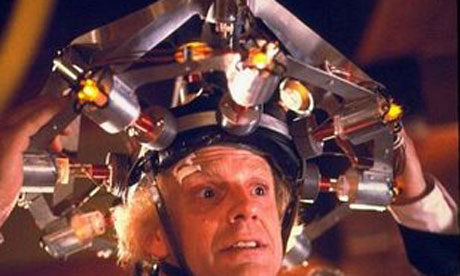
This is your brain on electricity

"Yes, Midge, I'm dying."

Whether cell phones hurt our brains -- and I'm not talking about the effects of chatting with your idiotic friends or having your boss find you on Saturday -- has been debated for years. A new study adds to the clamor:
Researchers from the National Institutes of Health have found that less than an hour of cellphone use can speed up brain activity in the area closest to the phone antenna, raising new questions about the health effects of low levels of radiation emitted from cellphones. 
The researchers urged caution in interpreting the findings, because it is not known whether the changes, which were seen in brain scans, have any meaningful effect on a person’s overall health.
As with the health effects of coffee, I urge you to remain calm: pour a cup and call a friend to talk this over.

The leader of the research, Dr. Nora D. Volkow, director of the National Institute on Drug Abuse, said:
“Unfortunately this particular study does not enlighten us in terms of whether this is detrimental or if it could even be beneficial. It just tells us that even though these are weak signals, the human brain is activated by them."
Dr. Volkow said future research may even show that the electromagnetic waves emitted from cellphones could be used to stimulate the brain for therapeutic reasons.
She said the research should not set off alarms about cellphone use because simple precautions like using a headset or earpiece can alleviate any concern. 
“It does not in any way preclude or decrease my cellphone utilization,” she said.
Never trust headlines: you have to read to the end of the New York Times article to get that.

"Hey, I have an idea!"
Meantime, we get this:
New scientific research suggests that by stimulating parts of their brains electrically, people can be induced to think more creatively than they normally do.  
The researchers took 60 normal, healthy, right-handed volunteers and asked them to try to solve a task that required clever insight. All of them were told they'd be receiving some kind of brain stimulation. But just 20% of the control group (who received no stimulation) could solve the task. That's compared with 60% of the volunteers who received electrical jolts to their brain--cathode stimulation of the left ATL (anterior temporal lobe) to suppress activity and anodal stimulation of the right ATL to increase activity.
Shocking.